
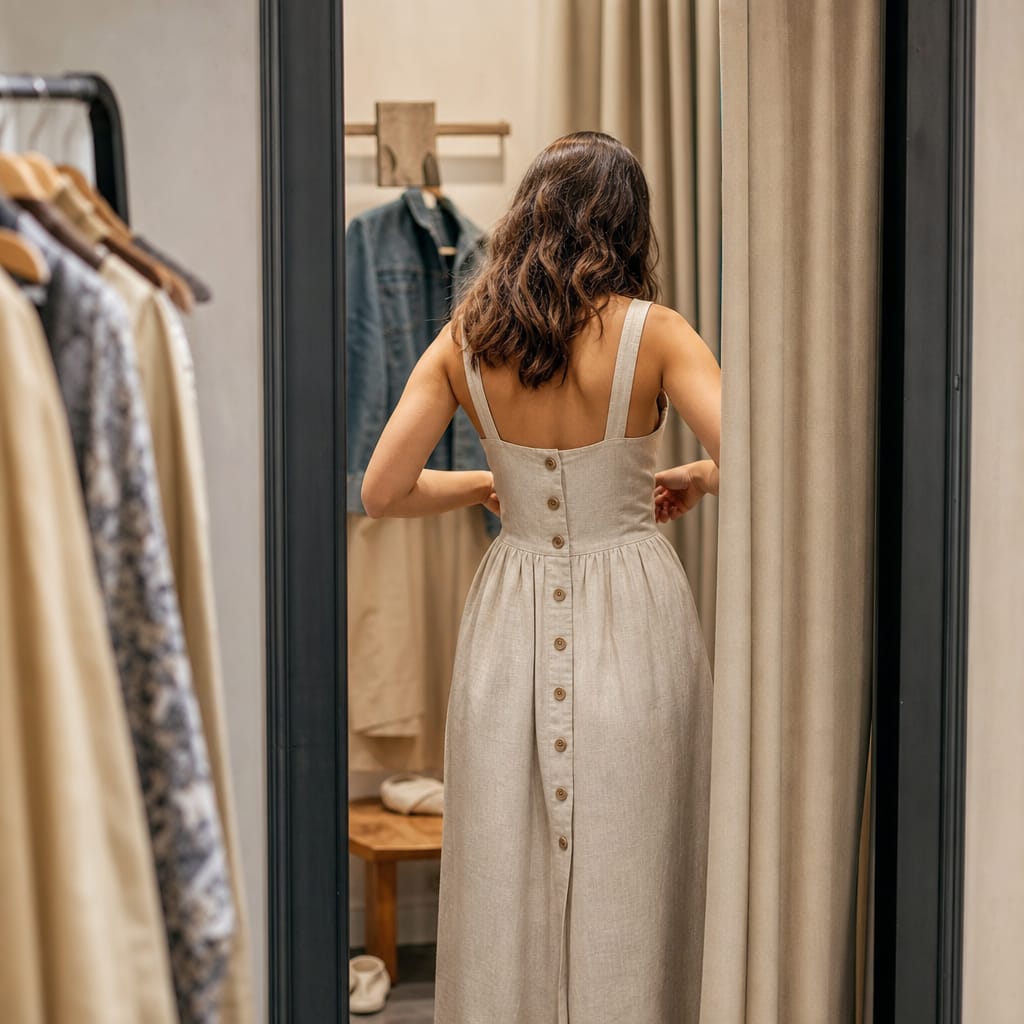
There is a moment, familiar to almost anyone who has ever tried on a shirt or a dress or a pair of trousers, where something is almost exactly right and yet somehow completely wrong. The shoulders sit perfectly. The chest is fine. And then there is this strange gaping at the waist – as if the garment was made for a person who shares your measurements from the collar to the armpits and then abruptly becomes someone else entirely. You blame yourself, naturally. But the blame belongs to a mathematical process most people have never heard of, called grading.
Which sample size do British clothing brands draft from?
Every garment starts life as a single pattern, drafted to fit one specific size – often a size 10 or 12 in womenswear, depending on the brand. That pattern is the template from which everything else is built. But a clothing range needs a size 6 and a size 22 as well, and here is where grading comes in. A grader takes that original pattern and scales it outward or inward through the rest of the size range, adding or subtracting a fixed amount at specific, carefully chosen points around the pattern pieces.
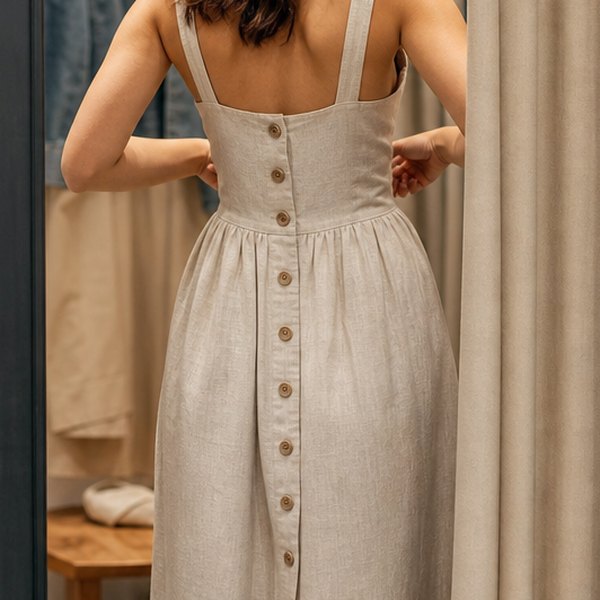
The word is "specific". Grading is not the same as zooming in or out on a photocopier. If you enlarged a size 10 pattern uniformly by 15% to get a size 16, you would end up with a garment that was also 15% longer in the torso, 15% wider in the shoulders, 15% bigger in the armhole. None of which necessarily reflects how a real body actually differs between those two sizes. Real bodies do not grow evenly in all directions at once. So graders follow a set of rules that dictates exactly where the extra centimetres are added: a little at the side seam, more at the waist than the hip, almost nothing at the shoulder. Those rules are called grade rules, and they are where things get genuinely complicated.
The Politics Sewn Into the Seams
Grade rules are not handed down from nature. They were developed by manufacturers over decades, based on fitting data and, bluntly, based on assumptions about what the "typical" body looks like as it gets larger. The problem is that those assumptions bake in a particular body shape – one where the waist-to-hip ratio stays more or less constant as size increases, where the bust grows in step with the back width, where the torso doesn't lengthen much.
For a significant proportion of actual human bodies, these assumptions are simply wrong. Larger sizes often involve a different distribution of volume altogether, not just more of the same shape. When the grade rules don't match the body, you get that waist gap, or the sleeve that pulls, or the neckline that sits oddly on one size and fine on another.
Some brands are now attempting to redraw their grade rules using updated body-scanning data rather than the mid-twentieth-century fitting studies that originally underpinned most of the industry's standards. For a look at how computer vision is changing the way we measure and model things – including bodies – When the Machine Sees Better Than You Do.
Why It's So Hard to Fix
Changing grade rules sounds straightforward enough, but it means a brand essentially has to rebuild every pattern in its range from scratch. That's expensive and time-consuming. It also means accepting that there is no single "base" body shape that scales neatly in all directions – which the whole system of standardised sizing quietly depends on.
So the next time a jacket fits you perfectly across the back and then billows strangely at your waist, it isn't your body that's the awkward one. It's the maths.
Questions this raises
- How do pattern graders decide where to add width?
- Does vanity sizing make grading problems worse?
- Can alterations fix a badly graded garment?