

There's a word hiding inside "automatic" that most people walk straight past. Auto. From the Greek for "self." Which makes automation a slightly odd concept when you think about it – because whose self, exactly, is doing the acting?
In printmaking, the question isn't just philosophical. It has ink on it.
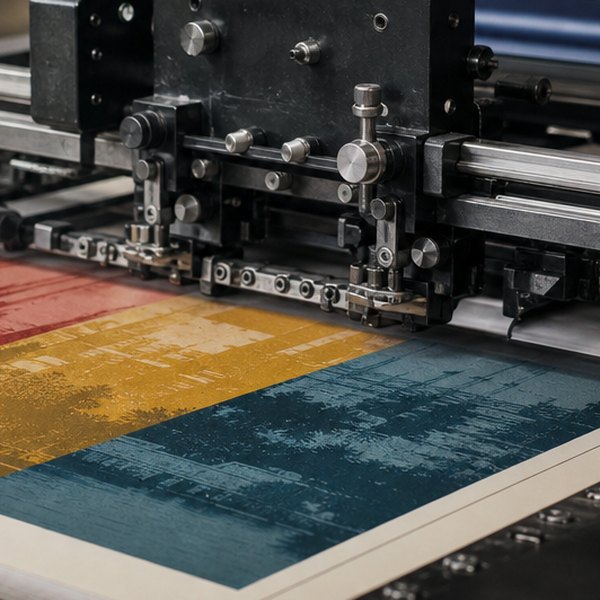
How do printmakers line colours up by hand?
Colour printmaking is a layering game. You're not printing one image; you're printing four, or six, or twelve. Each a different colour. Each landing on exactly the same spot on the paper, each pass through the press building the picture like geological strata. Get the alignment – the registration – even half a millimetre out and the finished print looks like it's had a few drinks.
For most of printing history, the human eye was the quality check. Tiny crosses and corner marks, printed in contrasting colours, let the printer see at a glance whether the plate had shifted. Red over cyan. Green over magenta. Everything calibrated, reasonably quietly, around the assumption that you could see the difference between those two things.
The Fallback That Wasn't There
A colour-blind printmaker using a press with auto-registration faces a specific situation that isn't discussed much. The machine aligns each pass using sensors and mechanical stops – it doesn't look at the colour marks, it reads geometry. Which should mean it works fine for everyone, and it does. But here's the interesting part: when the auto-registration drifted slightly and needed correcting.
A sighted printer's instinct is to glance at the registration marks, spot the colour misalignment, and nudge the plate. Two seconds, done. For a colour-blind printer, that visual shortcut simply isn't available. The correction has to come from somewhere else: from understanding exactly what the machine is actually doing, mechanically, to hold each layer in place.
Which means learning the system properly. The stops, the pin registration, the tolerances, the actual physics of why the paper moves or doesn't move. Not as a backup to the colour check, but as the primary method.
The Part Everyone Else Skipped
What colour-blind printmakers discovered, empirically and by necessity, is that the auto-registration system is more reliable than the colour-mark glance. The human eye, it turns out, is doing something impressionistic when it checks alignment – it's close enough, it looks right, carry on. Given correct setup, the machine holds tolerances that the eye would never catch drifting.
The visual workaround everyone else used was masking a small, consistent inaccuracy. Reliable enough, most of the time. But "most of the time" isn't the same as understanding what the system is actually doing.
What Self Really Means Here
Auto, as in automatic, was supposed to mean the machine acts for itself, freeing the human from fiddly checking. What it did, for the people who couldn't fall back on colour vision, was force a much more precise relationship with the mechanics underneath.
The system that looked neutral – universal, helpful, just a tool – was quietly built around one way of seeing. And the people it left out ended up, by necessity, understanding it more exactly than anyone else.
That's not a neat lesson. It's just an interesting thing that happened.
Questions this raises
- Does a machine-registered print still count as original?
- What registration tolerance is considered acceptable?
- When did presses start registering colours automatically?