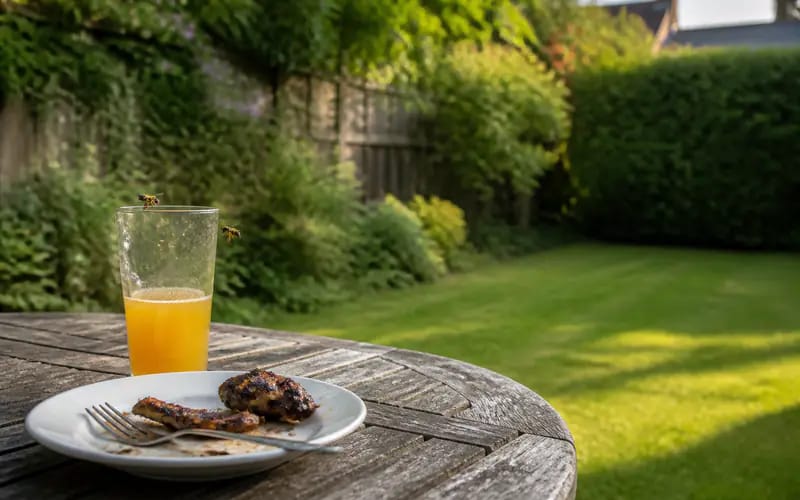
By early September your garden table becomes a wasp nightmare and all your open drinks and leftover BBQ food seem to attract small crowds of wasps. The reason for this is simple really. By September time the wasps have been busy all summer long looking after the colony and then suddenly there is nothing for them to do. So, a nest full of fed up wasps with nothing to do search out something sweet to eat and that something sweet could be your pop or your BBQ food but also your drink!
Spring: One Queen Starts It All
Each wasp nest starts with one Queen who has survived the winter on her own in a shed, loft or log pile. In spring the Queen wasp builds a small nest of paper like material and starts to lay eggs. The first workers to emerge from the eggs start to help the Queen with the nest and she stops foraging for food. All the worker wasps are female and they do all the foraging, building and looking after the larvae in the nest.
Summer: Worker Numbers Build Up Fast
The queen, once she has produced the first workers, ceases to forage and to add to the structure of the nest. All her time is then devoted to laying eggs. The workers now add to the structure of the nest, forage for food to feed on, and go on long sorties to catch and bring back live prey to be added to the feed of the growing larvae. The colony now can contain several thousand workers all frantically rushing about the entrance of the nest.
Late Summer: The Queen Stops Laying
Late Summer: All Change as the Queen Changes Production
By late Summer the colony’s focus changes and the Queen slows down her egg laying of new workers and starts to produce large numbers of new Queens and males, which will disperse from the nest to mate in the following weeks. The Royal Horticultural Society describe this time of year as a period when there are far fewer larvae being looked after by the workers, so there is less for them to do. They leave the nest and start looking for sugar to take back to the nest.
Jobless Workers Turn To Sugar
Throughout the summer adult wasp workers live on sugary liquids produced in the nest by larvae for most of the season. The few instances where they forage for other insects are to feed these same larvae. Thus for most of the season the sugary liquids produced by the larvae are their main source of sugar for adult wasps. This supply ceases when the larvae are reared to adulthood and then leave the nest. For a time or two after this the wasps may appear to be few and not too much of a problem but within a few days all the adult wasp workers seem to have lost their jobs and start searching for other sugary liquids.
The Useful Job Wasps Do All Summer
As is often the case with insects that are seen to be of use during the growing season but that are unwanted in gardens and homes during late summer and autumn, wasps are, in reality, beneficial during the spring and summer months. As social wasps, species of wasp in the UK are estimated to consume 14 million kg of insects, such as aphids, caterpillars and other pests, during the growing season, had they not been eating them, the potential damage to crops and garden plants would be huge. The free pollinators are a huge, largely unseen, expense to our country, a point covered in an older piece. By September the wasps have done their job and are now seen to be of no use. If you want why are there so many wasps in september, https://trivialmouse.co.uk/nature/the-most-expensive-free-thing-in-britain/ is a good place to start.
Should You Ever Destroy A Nest
Many people believe that a wasp nest is a problem that needs to be destroyed, but in reality, a wasp nest only becomes a problem if it is in a situation where it is going to be constantly disturbed, such as near to a door, or in a loft that is frequently used. A nest is only used once a year by a single Queen and is then abandoned for good to be broken down by smaller insects. It is often better to leave a loft or hedge nest alone. There is published guidance on the lifecycle of the common wasp that covers this in more detail.
What Happens To Wasps Over Winter
By late autumn, the single Queen from the colony in the previous summer will have found a suitable place to spend the winter such as in a shed, loft or log pile and she will hibernate alone until the following spring when she will start to build a new nest and begin the cycle again. By the time your garden table turns into a wasp hangout in September the wasp colony will have long since finished its useful work and will have headed indoors to storage to be forgotten until the following year.
FAQ
Are wasps more aggressive in September? The answer to this is no, there is no change in wasp behaviour or temperament. However, the workers that have been fed by the larvae all summer are now searching for sugary substances to eat and therefore encounter humans more frequently.
What Happens to Wasps in Winter? As temperatures drop in winter the wasp’s life comes to an end. The vast majority of workers and males will die off in the autumn and winter but the newly mated queen wasps will find a sheltered spot over winter such as a shed, loft or log pile and hibernate until the following spring.
Is it necessary to kill a wasp nest? It is only necessary to destroy a wasp nest if it is in a position to be continually disturbed by humans. An undisturbed nest in a loft or hedge left undisturbed will be abandoned by the end of the summer and be empty by winter.
How long does it take for a wasp sting to become an emergency? Swelling of the lips and/or throat or difficulty breathing at all requires an immediate call to 999 and treatment for a serious allergic reaction.