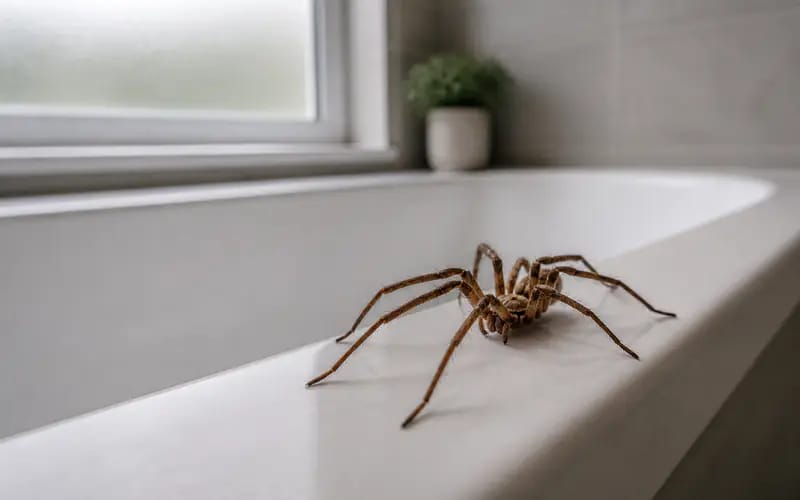
Each year across the UK in the months leading up to winter, larger and more speedy spiders start to appear in baths, hallways and under skirting. So why do the spiders start to seek warmth in September? The reason behind the sudden influx of spiders seeking warmth in September is to do with mating.
Myth 1: They Come In From The Cold
This is another widely held myth, and it is incorrect. The Natural History Museum describes the sudden appearance of spiders inside properties in September as part of the life cycle of the male house spider. The males of the species leave their webs late in the summer and set off in search of females. The majority of sightings of house spiders in September are of these males searching for a female’s web.
Myth 2: There Are More Spiders This Year
Sightings may appear to increase significantly each year in September as part of a massive increase in spider numbers, but in reality the majority of spiders are simply behaving in a particular way, and entering houses in ways that we are not familiar with. Numbers of spiders have not increased significantly, but our encounters with them have. This is largely due to windows and doors having been left open throughout the summer to allow cool ventilation, and the wandering males simply entering through all of the available routes.
Myth 3: They Are Dangerous
Big spiders can look rather frightening, but they pose no risk to humans. UK house spiders are not agressive and their bites are extremely rare. In fact the bites are likely to be as painful as a wasp sting and there is nothing that any of the species of spiders native to British houses carry that could cause any human illness.
Six Spiders You Might Spot
While many species of spider can be found in houses throughout the year, the majority of species that are seen are part of two closely related genera, Tegenaria and Eratigena. The giant house spider (Eratigena atrica), and the Spider Soldier (Eratigena saeva) are two of the largest and most commonly encountered species. However, the most commonly found species are considerably smaller. The domestic house spider (Tegenaria domestica) is one of the most common species found within houses. It is a small, pale yellow-brown coloured spider about 3 to 4cm across with a mottled pattern on its back. The Cardinal Spider (Tegenaria parietina) is Britain’s largest native spider with a leg span of up to 12cm and a reddish-brown colour. Another large species is the barn funnel weaver (Tegenaria cuznitskyi), about 5 to 6cm long, grey-brown in colour and not as chunky as some of the other species. Finally there is the lace web spider (Amaurobius similis). This is a small spider of about 2 to 3cm long, with a mottled dark colour and it tends to stay closer to cracks and crevices in walls and tends to make a ‘lace-like’ web.
What The Roaming Males Are Actually Doing
These big, fast spiders are all male. They have been living in your loft all summer and have now left their webs in search of females. In many species of spiders the males die within a few days of mating. Sometimes the female will even eat him, but more often he just dies of exhaustion. The females of the species stay in or near their webs all year and often survive through the winter to produce a new brood the following year. Information on the life cycles of many invertebrates found in British gardens and houses during autumn can be found on our autumn invertebrate activity pages. why do spiders come in the house in September is covered in more detail at https://trivialmouse.co.uk/nature/every-living-thing-has-a-label-and-it-s-more-like-a-tin-of-beans-than-you-d/.
Common Entry Points And Simple Fixes
Most spiders gain entry into our homes through similar means to which cold air enters them i.e. via gaps under external doors, chimney Flashing that has not been sealed, cracks in and around pipework and via open windows. Sealing up these potential entry points with a simple draught brush along the bottom of doors, placing a cap on unused chimney stacks and the likes of silicone sealant in cracks around pipes should all help to prevent encounters with the eight legged variety. As they slip under the door to which you’ve unwittingly let them in, there’s no need for forms, bureaucracy or even the checks with which a new company director is currently beset – all to verify your identity for Companies House. For the truly repulsed a glass with a card inserted within the lip of the glass is a far more effective and less distasteful means of capturing a spider than most of the special devices available on the market.
Common Questions
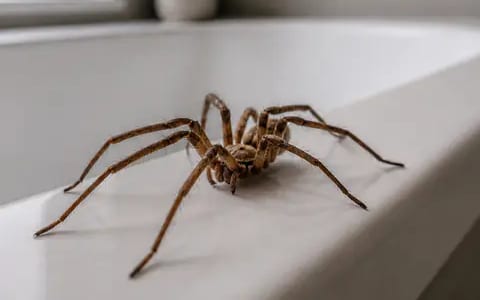
Why are large spiders entering homes in autumn? The main reason is that male spiders of the species leave their webs in September in search of females.
A lot of people mistakenly assume there to be an increase in numbers of spiders but in reality there are not. The houses that spiders find easiest to enter are usually those with open windows and doors, much the same as with humans.
How do they get in? Through open windows and doors, down chimneys and under the gaps around external doors and pipes.
How long do spiders live for? Do they come back next year? Male house spiders die within a few days or weeks of mating while female house spiders can live until the following year.
A worry about spiders are they harmful? No, the UK house spiders are not harmful to human beings, even though they may look very fearsome in a bathroom.