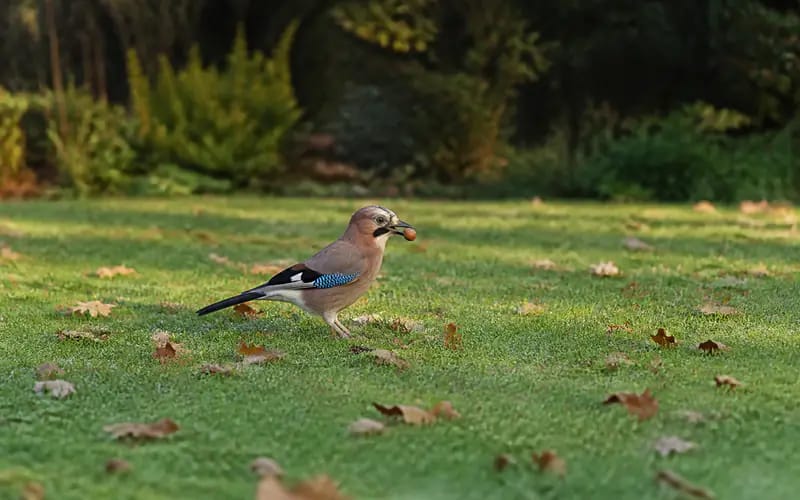
From late September through to early October each year, the presence of jays in gardens becomes a familiar sight as they search for food to bury away in the lawn or under a plant in a border. The reason for their presence in such large numbers is simple – there is suddenly lots of food about, fallen from trees in the garden.
A Winter Food Store
Every year jays put in huge amounts of work storing up food for the winter in the form of hundreds of thousands of acorns which they can dig up later from their hidden caches to eat. Some birds manage to stash tens of thousands of acorns which are buried in hundreds of different spots around the ground, covered over with leaves, moss, and even pebbles or flakes of bark. Each acorn is buried singly, often only a few centimeters down into the soil.
How A Jay Carries Several At Once
The Jay does not pick up just one acorn at a time. Many are stored in the throat pouch and some more are carried in the beak. The Jay then flies with these acorns and drops them at long intervals from the parent tree. Many of these are in open spaces such as lawns where the young saplings will have a better chance of growing up without tree competition than those that fall near the parent tree.
Why This Peaks In Autumn
The reason we see Jays in gardens throughout September and October is because the acorns on English Oak trees start to ripen in September and then drop in the following months. As the food becomes available in large quantities within a short time-frame the Jays hurry to make the most of the large amounts of food available before winter sets in.
Do They Remember Where They Put Them
A large proportion of jay caches are recovered but not all are dug up again. A significant number will be forgotten, have been buried by another jay and not recovered by the original owner or even have been killed over winter and reopened by other animals such as rats and woodpeckers. Some caches are never needed as the jay has found an easier food source.
The Knock-On Effect On Woodland
Each of the acorns that jays fail to recover can grow into an English oak tree, planted at the correct depth and in suitable open ground. For thousands of years jays have been spreading oak through the country and a recent report by Forestry England into the Spread of Trees noted that jay burying of acorns helped recolonise the country by oak trees following the last Ice Age, with the trees spreading faster than they would have done had they simply been dropped by trees as seed.
How To Tell A Jay In Flight

A Jay is a medium sized bird with a pinkish-brown back and wings and white and black streaking on its crown. In flight the bright blue and black stripes on its wings are obvious as well as the white rump patch. Jays have a harsh screeching call, which is often the first sign of their presence. Why do jays bury acorns is worth getting right.
What This Means For Your Garden
As we established earlier, a jay’s burying of acorns or your garden pond’s peanuts in your garden lawn or flowerbeds are most likely to be signs of a jay treating your garden as part of its wider territory for the autumn for food storage. e. ‘sites of refuge’. Your average garden contains most of these characteristics in the form of lawns and borders.
A Wider Pressure On Woodland Wildlife
It is not all good news for wildlife in the countryside however. A growing population of another species is putting increasing pressure on a variety of woodland birds and plant species.
A useful reference for why do jays bury acorns is https://trivialmouse.co.uk/nature/the-boom-that-s-quietly-terrible-for-wildlife/.
FAQ
Why have the jays suddenly appeared in the garden? Jays can disperse widely and start to cache food in gardens in the autumn as part of their normal behaviour. For more on this see Bird Monitoring by the BTO where our jay detections peak in autumn.
Do jays remember where they have buried their acorns? Jays remember a large proportion of their caches from the previous winter, but many are forgotten. Those that are not recovered can germinate and grow into oak trees.
Q: How to tell a Jay? A: The Jay is pinkish-brown, black and white striped with a very bright blue and black striped wing, and a white rump which can be seen when the Jay flies away from you. The call of the Jay is very harsh and ‘screechy’.
Does the Jay eat the acorn or just store them for later? The Jays really do eat many of the acorns but caching them ensures a constant food supply for the Jay during the very lean winter months.