By late September, all the Swallows that had bred in the UK for the year have usually departed for their wintering grounds in South Africa, although there may be a few late stragglers around in early October. By this time, the gardens and houses where they nested will be empty once again, and the birds that have been seen flitting around in late summer will have vanished.
When Swallows Actually Leave
By early October most Swallows have departed the UK although a few stragglers remain until the end of the month. These may be late fledging juveniles that are still to gain sufficient strength to fly to Africa or older birds that have remained behind to try and raise a second brood. Some years there are late stragglers but these are unusual and most years Swallows have departed by the end of November.
Why They Leave When They Do
It’s not the cold weather that sends Swallows off on their migration, but the decline in flying insects that they eat during the summer. Although it is possible to see individual Swallows on occasions during very mild weather in winter, the bulk of the population travel to warmer parts of the world for the winter. The research into the bird migration times suggests that day length has the greatest effect on the timing of the migration and this affects the hormones which prepare the bird for long-distance flight whilst there is still plenty of food about.
Spotting Pre-Migration Gathering
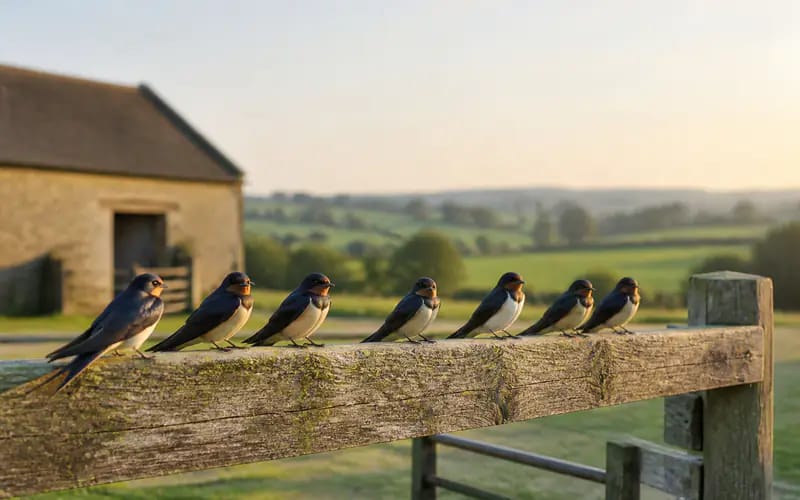
While the swallows are getting ready to leave, a few gather on wires, on house roofs, on fence posts, sometimes mixed with house martins. They are building up their bodies for the long flight ahead of them. Later, in the days leading up to their departure, they go on shorter and shorter trips from the nest in search of insects to eat. The sign of the swallows’ departure in the Wildlife Trusts’ Seasonal Wildlife Notes for September includes swallows ‘lining up on wires’, ‘gathering on roofs’, ‘chattering’ and ‘feeding near nest’. Listen to the chattering of swallows in the article Birds’ song reveals hidden layers.
Where They Go And The Route
UK swallows travel down through western Europe and cross into the Iberian Peninsula before passing over or around the western edge of the Sahara. It is believed that most British Swallows migrate to central and southern Africa for the winter and that the journey can take less than a month. On the way they will stop off to re-fuel on insect prey. The birds’ departure from the UK and their arrival at their African wintering grounds can be several weeks apart.
How Timing Compares With House Martins
The departure dates of house martins follow a similar but slightly later pattern to that of the Swallow. In many parts of the country house martins will still be present until September and even, occasionally, until early October. They can often be seen together with late Swallows on telegraph wires. As with the Swallow, however, the exact location of the British house martin overwintering in Africa has yet to be confirmed by ringing studies, despite many years of work on this species. There is more on when do swallows leave the uk at https://trivialmouse.co.uk/nature/the-part-of-birdsong-you-ve-never-actually-heard/.
How Swift Departure Differs
Swifts, however, depart the country in early August and are seldom seen around the UK in late summer. By September, the time when Swallows are beginning to leave, the Swifts will have long since disappeared and late summer skies are often characterised by the absence of these birds. The screaming parties of Swifts are a familiar sound of summer, but by late August, they too have vanished and it is the time of the Swallows and House Martins.
Telling The Three Apart On The Wire
All three species of birds are likely to be found in UK gardens this time of year but are easy to tell apart. Swallows have long tail streamers and have a red throat patch. House Martins have a bright white rump and short forked tail and do not have any streamers. As for the swifts, they almost never perch on wires, roofs or even on the ends of branches. Their legs and feet are adapted to allow them to cling to vertical surfaces.
What A Late October Sighting Means
Just because the odd swallow has been seen in late October does not mean that it is in distress. It is more likely to be a late fledged juvenile, or a younger bird which has taken longer to get itself down to Africa for the winter, possibly delayed by a spell of poor weather. The odd late straggler can be expected most years, and although November sightings are rare, it is worth recording them.
Quick Comparison: Swifts, Swallows And House Martins
Swifts arrive late April to May, leave early August and head to Africa for the winter. Swallows arrive in gardens from March to April, leave from September and head to South Africa, the majority arriving within a month of each other. House martins arrive in April to May, stay around until September or October and the exact African wintering grounds have not yet been ascertained. To tell the three apart on a wire see the swifts, swallows and house martins identification page.
However, even the most familiar of birds can hold some surprises and that is certainly the case with the house martins.