
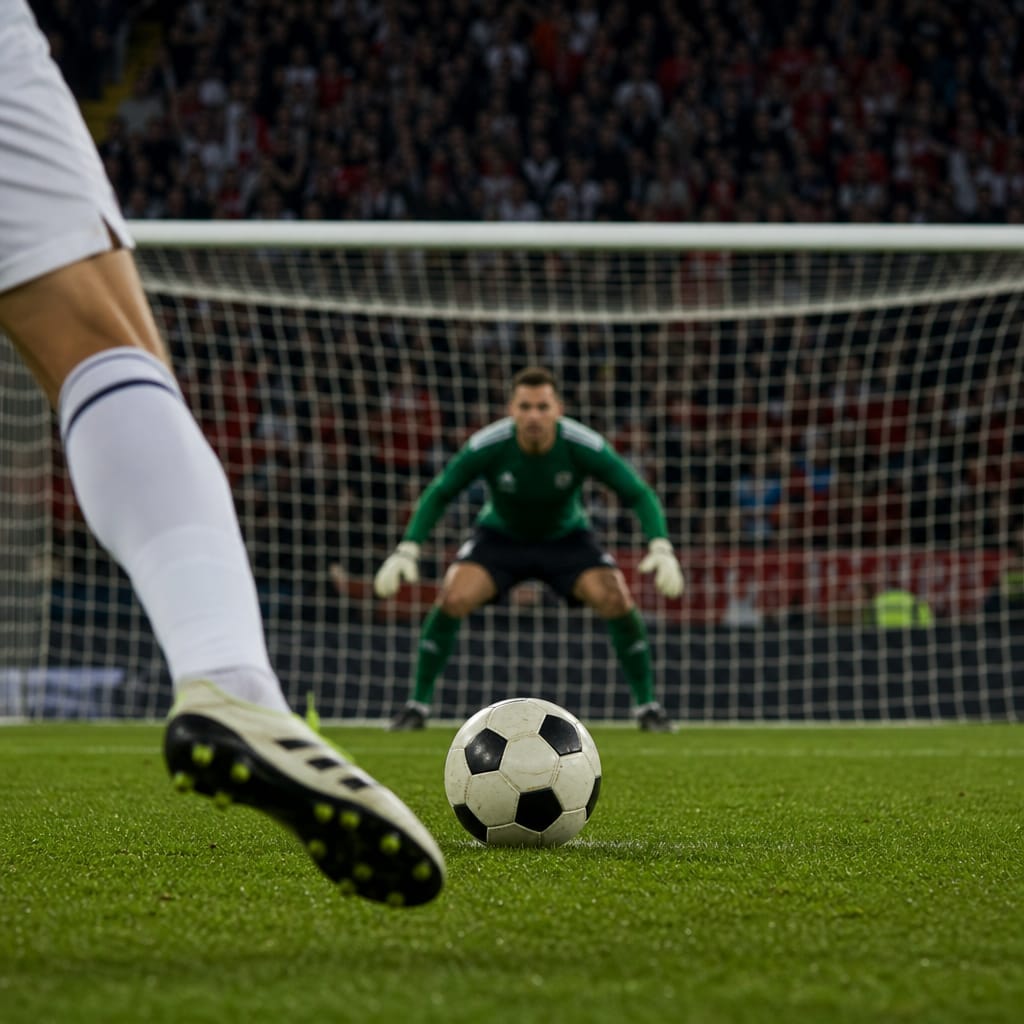
Think about a penalty shootout. Striker steps up, goalkeeper bouncing on his line, twenty thousand people holding their breath. The striker has one job: put the ball somewhere the keeper isn't. Simple enough. And yet the most reliable way to beat a goalkeeper is genuinely, truly, randomly pick a corner – the way you'd roll a die – with no preference, no pattern, no logic whatsoever. No gut feel. No "I went left last time so I'll go right." Just noise.
The problem is that no human being alive can actually do this.
The Pattern You Don't Know You're Making
Sports scientists have spent years asking athletes to "mix things up" and then measuring whether they do. The results are embarrassing. A penalty taker who believes he is varying his shots unpredictably turns out to be cycling through a sequence – left, right, left, left, right – that repeats itself across a match, a season, a career. He has no idea. It feels like variety. It is, statistically, a signature.
Cricketers are the same. A bowler who swears she is keeping the batsman guessing with her deliveries is, more often than not, working through a short loop: two outswingers, one straight, vary the length, repeat. She is not conscious of it. But a patient batsman who has faced her ten times starts to feel it, and then he hits her for four.
The reason is not stupidity. It is how brains work. We are meaning-making machines – we feel uncomfortable repeating ourselves because repetition feels like a giveaway, so we overcorrect and avoid it, which is itself a pattern. True randomness includes long runs of the same thing: three left-footed penalties in a row, five outswingers back to back. Our brains find this unbearable and step in to "correct" it. The correction is what gives us away.
The Edge a Computer Doesn't Have to Fight
This is where it gets strange. A computer generating random numbers doesn't feel the urge to vary things up. It has no discomfort with repetition, no instinct to second-guess itself. It produces genuine sequences that human intuition cannot predict – because it has no intuition to override the mathematics.
A computer watching a bowler or a striker doesn't bring intuition to that either. It just sees frequency data. It doesn't get fooled by a confident run-up or a meaningful look at one corner. The piece When the Machine Sees Better Than You Do gets into this: the machine isn't faster, it just carries no assumptions into the room. No heuristics. No hunches. That is its advantage.
Can a person be trained to behave randomly?
So what do elite players actually do about this? The clever ones cheat the system by outsourcing the decision. Some penalty specialists genuinely decide where they're going to shoot before they even walk to the spot, and then commit completely – the point being that if the keeper dives early, they don't adjust. Others use pre-agreed signals with coaching staff to assign corners to numbers, then pick numbers from a hat in training to build genuinely random practice habits. The goal is to take the brain out of the loop at the exact moment the brain most wants to be in it.
Which is a strange sort of discipline: training hard for years, then trusting a coin flip over your own judgement in the moment that matters most.
Questions this raises
- How do goalkeepers spot a penalty taker's pattern?
- Do clubs keep data on opponents' penalty habits?
- Should takers use a coin or watch to choose?