

There's a moment at the start of almost every business meeting that both people treat as pure ritual – the handshake. It means nothing, we all agree. It's just what you do before you sit down and get to the actual business. Except it turns out it isn't ritual at all. It's a chemical audit, and your body is running it without telling you.
How was the handshake sniffing study carried out?
Researchers studying human greeting behaviour noticed something odd: after shaking hands, people frequently bring their hand to their face. Not in an obvious, deliberate way – more a quiet drift, a half-second's unconscious detour. When they tracked this in experiments, they found people were steering their fingers towards their nose significantly more often after a handshake than at other moments. And the direction the hand went? That depended on who they'd just met – right hand towards the nose for a same-sex greeting, the sniffing shifted in different ways for opposite-sex encounters.
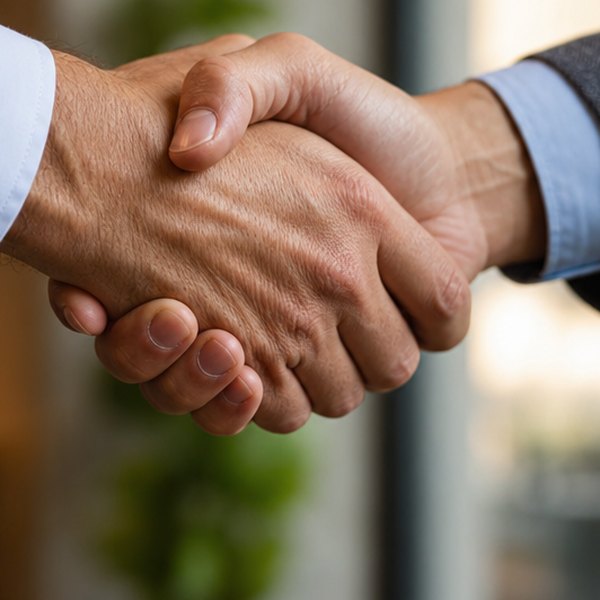
The conclusion is fairly startling. The handshake transfers a cocktail of chemical signals – compounds from the skin, traces of sebum, faint markers of immune profile and hormonal state – and the person on the receiving end unconsciously samples them. Not consciously, not deliberately. The conscious brain is already exchanging pleasantries and forming opinions about the firm handshake or the weak one, but somewhere slightly further back, the body is doing its own quiet assessment. And it's been doing it far longer than suits and boardrooms have existed.
What is being picked up from someone else’s hand?
The chemicals transferred during a handshake sit in a class called chemosignals. Some are broadly similar to what other mammals use to assess strangers – genetic compatibility markers, stress hormones, signals of health and immunity. Humans mostly think they've moved past that kind of thing. But the sensory wiring is still there, still receiving, just running below the surface of a conversation about Q3 projections.
For a business context this is a genuinely strange idea to sit with. The candidate who "just felt right" in an interview, the client you immediately trusted, the supplier who made you slightly uneasy without being able to say why – some fraction of all of that may be the nose's verdict, delivered quietly and laundered through intuition. For more on how touch and images carry meaning we've mostly stopped consciously acknowledging, this piece – What Pictures Used to Be Able to Do To You – makes the parallel well.
The Meeting That Starts Before It Starts
What this actually means for anyone who sits in meetings or interviews is simple: the handshake isn't a formality before the assessment begins. It is assessment, just run by a department of your brain that doesn't attend the debrief afterwards. The same goes for the other person.
None of which means you should stop shaking hands, or start thinking about your sebum before a pitch. The whole system operates below the threshold of anything you can deliberately manage. It just means the meeting started the moment your palms met – and your body already has an opinion.
Questions this raises
- Does hand sanitiser change what a handshake conveys?
- Do cultures without handshakes greet by smell instead?