
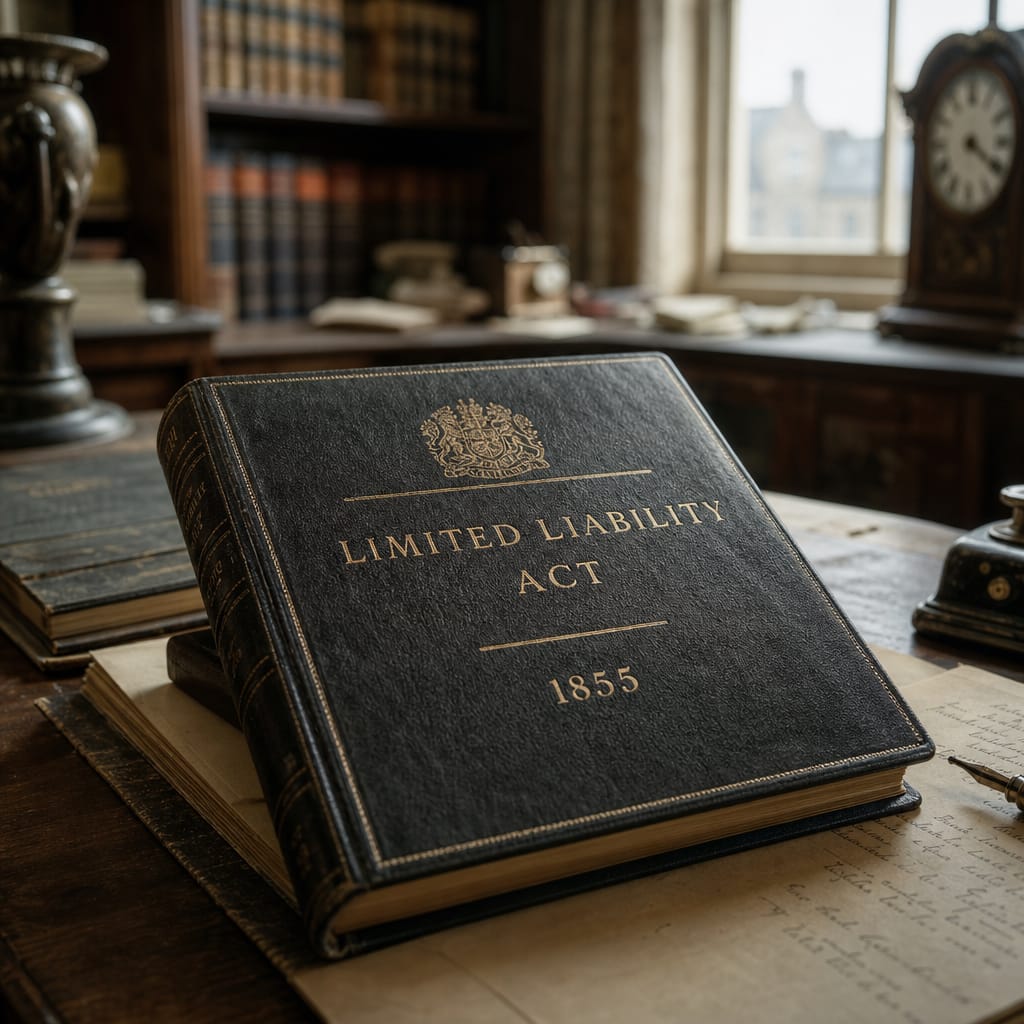
Imagine it's 1845 and you're a solicitor in Derby. Reasonably comfortable. A decent house, a bit of savings. A friend tips you off about a new railway venture – the line between two northern towns, almost certainly profitable, everyone says so. You put in a few hundred pounds. The company collapses. The debt collectors come not for the company's assets but for yours: your house, your furniture, the clock in the hall. Under English law at the time, if a company you'd invested in went bust, you owed what it owed. All of it. Personally.
This was not a rare disaster. In the 1840s, railway mania swept Britain like a fever. Hundreds of speculative railway companies sprang up; sober, careful people poured savings into them; most of the companies failed. And the legal carnage that followed was extraordinary – families wiped out not because they'd borrowed recklessly but because the law made no distinction between a person and a business they happened to own a share in. You and the company were, legally, the same thing.
When did limited liability become law in Britain?
Parliament watched this unfold and then, in 1855, did something quietly radical. The Limited Liability Act created a legal wall between an investor and their company. Once a business was registered as a limited company, its debts belonged to it – not to its shareholders or owners. If it went under, you could lose what you'd put in, but that was as far as it went. Your house stayed yours. The clock stayed on the wall.
The phrase "limited liability" is exactly that: your liability, your legal exposure, is limited to what you chose to invest. Not your whole life. Not everything you'd spent twenty years building.
The Extraordinary Trick of Being Two Things at Once
What makes this strange and interesting, if you stop to think about it, is that it invented a new kind of legal fiction. The company became a person – in the eyes of the law, a separate being that could own property, owe debts, sue and be sued. And you became a different person standing alongside it. One human being could now be two legal entities at once: themselves, and also their business.
This sounds like an accountant's technicality, but it changed who could participate in commercial life. Before 1855, starting a business was a bet-the-house move – sometimes literally. After it, a cautious, modest person could build something, take a crack at it, and know that failure wouldn't necessarily mean total ruin.
What "Ltd" Still Does Today
When you see "Ltd" after a company name, it isn't decorative. It is still that Victorian wall, still standing. It tells anyone dealing with that company: beyond these assets, you cannot come for the owners personally. It makes the terms of a deal legible to both sides before anyone signs anything.
The letters are a signal that the catastrophe of 1845 – the solicitor in Derby, the clock in the hall – has technically been ruled out. Not impossible, but no longer the default.
Questions this raises
- What happened to investors ruined by railway mania?
- Does limited liability still fully protect company directors?
- How many railway companies actually failed in the 1840s?