

Before the railways, seeing a significant painting meant one of two things: you owned it, or you knew someone who did. The great collections sat behind the walls of country houses and London galleries, and if you lived in Bradford or Newcastle or Birmingham, they might as well have been on the moon. A painting could not be posted. It was heavy, fragile, vulnerable to damp, and the roads were bad enough to rattle a canvas loose from its stretcher in an afternoon.
Art, for most people, was simply elsewhere.
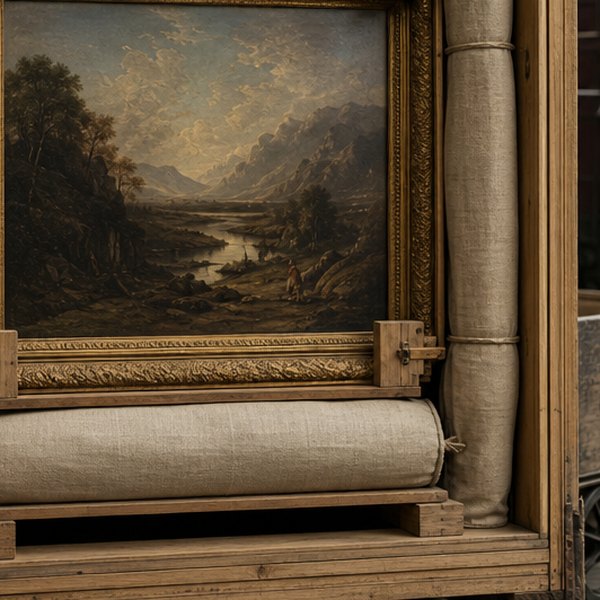
Then the railways changed the logistics, and the logistics changed everything.
Twelve Cities, One Summer, No Damage
By the 1850s and 60s, Britain had a freight network that ran on timetables. Goods left Manchester on Tuesday and arrived in Edinburgh by Thursday, reliably, in covered wagons, without spending three nights on a wet cart. For heavy, awkward, temperature-sensitive objects this was a revolution. A small group of exhibition organisers quietly noticed it.
The travelling exhibition circuit that developed across the mid-to-late Victorian period worked roughly like this: a major show would open in London, run for a few weeks, then the whole thing would be crated and loaded onto a freight train and sent to Birmingham. Then Leeds. Then Bristol. Then Liverpool. A single exhibition might visit ten or twelve cities in sequence across a year, the paintings travelling in specially made wooden crates with padded interiors, packed according to conventions that organisers had worked out through trial and error – never stacking canvases face to face, always allowing air circulation, always shipping frames separately.
The paintings arrived intact. People came to see them in their thousands.
Saturday in the Gallery
Here's the part that tends to get lost when people talk about Victorian art. The travelling circuit didn't just distribute paintings geographically. It turned "going to see art" into a working-class Saturday activity, in the same category as going to a music hall or a football match, and entry prices were kept modest specifically to fill the halls. In Leeds and Sheffield, attendance records from some exhibitions run into tens of thousands of visitors in a single week.
The effect on what actually got made was real. Painters who wanted to reach this new audience learned, consciously or not, to paint big, legible, narrative pictures – the kind you could read from twenty feet away in a crowded room without a catalogue. Scenes with a clear emotional story. A soldier coming home. A widow. A moment of grace or ruin, obvious at a glance. The railways had created an audience, and that audience had tastes, and those tastes pulled at the market.
The Invisible Infrastructure
None of this appears much in art history books, which tend to discuss Victorian painting in terms of movements and influences and who was friends with whom at the Royal Academy. The freight schedules don't get a mention.
But the next time you see one of those enormous, slightly melodramatic Victorian canvases – the ones with the weeping woman or the dramatic seascape – bear in mind they weren't made for a duke's dining room. They were made to travel by train, to be seen by a crowd, and to be perfectly legible to someone who'd never been inside a gallery before in their life.
Questions this raises
- Which cities received the travelling art exhibitions first?
- How were paintings packed for rail transport?
- Did railway exhibitions lead to permanent city galleries?
- What did entry to a Victorian art exhibition cost?