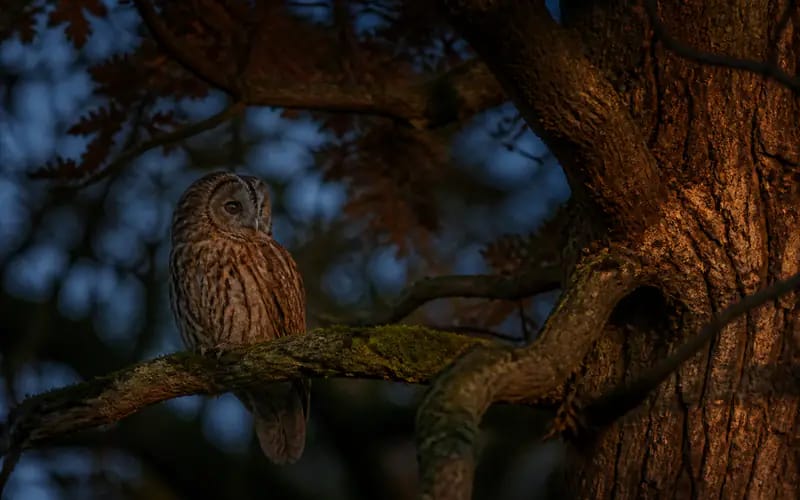
If you’ve ever heard a peculiar, wavering hoot of sound in the evenings of autumn days, you may have thought it was one of our Tawny Owls shouting out “twit-twoo”. But in fact, the famous call that everyone recognises as the voice of our woods at night is actually made by two different birds. In fact, once you’ve learned what each of them is doing, you’ll find that nights in the gardens of rural Tawny Owl haunts become much more interesting.
The Twit-Twoo Myth Explained
We all know owls go about calling their famous ‘twit-twoo’ but the fact remains that this is made up of two calls, not one. In fact the Female Tawny Owl will often give a short sharp call of ‘kee-wick’ and then the male will respond with his long wavering hoot. It’s not uncommon for the two to be given in close proximity to each other and for the folk memory of these calls to be ‘stitched together’ to give the impression of one bird calling both halves of the ‘twit-twoo’!
The Male’s Hoot
The male’s long, wavering hoots can be held on a long note for some time before dropping to a short pause, and then dropping again to a wavering, tremulous tone that can travel for miles on a still night. He uses this sound to advertise his presence on his patch as well as to call to females. This is the sound that most people associate with Tawny Owls and is used in film and television to depict them. The hoots are most commonly heard between dusk and dawn, although it is not unusual to hear them during the day too.
The Female’s Sharp Kee-Wick
The female’s contribution to the tawny owl’s calls is a sharp, short sound of a single note, often repeated several times in quick succession. She uses her ‘kee-wick’ calls to answer the male’s hoots, to let the male know where she is, and occasionally she will use her ‘kee-wick’ calls as a contact call to other females not part of her pair.
It’s worth noting that the female’s ‘kee-wick’ calls are often missed by people as they are so different from the male’s hoots and are therefore not associated with the ‘twit-twoo’ calls of tawny owls. If you listen carefully to recordings of tawny owl calls or even go for a walk in a woodland at night and hear tawny owls calling, you will often hear the female’s ‘kee-wick’ calls interspersed within the hoots.
Juvenile Begging Calls
Young owls, that have left the nest, will continue to be fed by their parents until they learn to hunt for themselves. They make very high pitched sounds, almost like a squeak, often in a repetitive manner. They will make these sounds until they have found a territory of their own, and will often travel over a large area before settling in a particular spot. Their sounds can often be confused with that of an adult Tawny Owl, however they are very distinct.
Why October Is So Noisy
September and October are the two most vocal months of the year for tawny owls. There is usually a massive increase in calling as this year’s young owls leave the area of their birth and set off to try and find a suitable territory of their own. Established tawny owls will up their calling during the autumn to try and defend their own patch against the interloper. This increased calling is not due to cold weather or short days, it is purely a matter of tawny owl territory defence.
Telling Male From Female By Ear

Males’ hoots and females’ kee-wicks can be distinguished by pitch and length of call. The hoots of males are low-pitched, long to varying degrees and contain a lot of variation, especially at the end. Females’ kee-wicks are short and sharp, slightly higher pitched than the hoots and often sounding like a question. It is not unusual to hear both males’ and females’ calls and for them to be overlapping with the other bird answering within a second or so. These are mated birds in contact over their shared territory. The calls of tawny owls can easily be mistaken for those of other species of owl such as barn owls or little owls but these birds make completely different sounds and are often wrongly attributed for the hooting of tawny owls. There is more on tawny owl calls at https://trivialmouse.co.uk/nature/the-part-of-birdsong-you-ve-never-actually-heard/.
The BTO’s Tawny Owl Calling Survey
This data comes from the BTO’s Tawny Owl Calling Survey of 2018-19 autumn and winter nights when people went out to listen for tawny owls to count and record calls in gardens and woods all across the country. Some 9,000 or so people across the country took part on various nights and the resulting data has been used to map out tawny owl calling activity throughout the year in a variety of different habitats.
For other sounds that are easily overheard, see birdsong details most people miss.
Frequently Asked Questions
Is ‘twit-twoo’ one owl? No, the female Tawny Owl’s sharp ‘kee-wick’ call is answered by the male’s long hooting sound, thus two different birds are calling in this well-known sequence of sounds.
In Ireland tawny owls are heard during the autumn and winter months in the grounds of many universities and in a number of other locations throughout the country. Why are the tawny owls so loud this year? This year’s young are leaving the area of their parents’ territory and the established pair are defending their patch against these newcomers.
Q: Do Tawny Owls live in Ireland? A: No. Tawny Owls are found in England, Wales and Scotland but not in Ireland according to the RSPB.
How long do tawny owls live? Ringing has shown that some individuals can live well over 20 years and return to the same territory year after year.
Next time you hear a tawny owl in your garden on an autumn evening, remember it is not just one bird calling, it’s a male and female pair calling to each other across the garden.