

Somewhere in the gap between the Grand Tour and TripAdvisor there is a profession that vanished so quietly nobody wrote an obituary. Not the travel agent in the high street, who mostly just handed you a brochure and took a commission. Further back than that. The dragoman.
The word comes from Arabic, by way of Ottoman Turkish. If you were a wealthy European in the eighteenth or nineteenth century heading into anything that wasn't western Europe, a dragoman was somewhere between a guide, an interpreter, a fixer, and a human route-planning engine. He had physically walked the road. He knew which caravanserai had decent beds and which had rats, and he knew the going rate for a mule, the name of the official you needed to bribe in Cairo, and precisely how insulted to pretend to be during a negotiation so that everyone came out of it with their dignity intact.
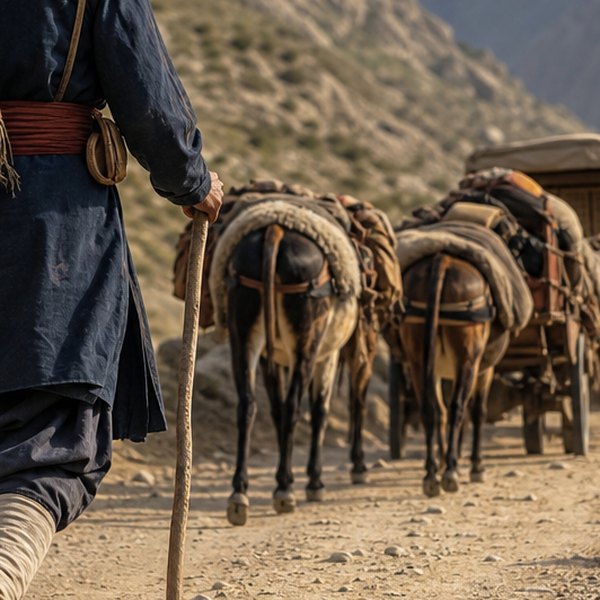
The Job That Money Had to Buy
For a wealthy traveller on the Grand Tour of the 1700s, a courier – the European equivalent, slightly less exotic, equally essential – was not a luxury. He was infrastructure. Without him, you did not know which Alpine pass was open, which inn was full, or whether the road ahead had been washed out. He ran ahead of the carriage. Literally, sometimes. He negotiated rooms and prices in real time, in the local language, in a world where there was no other way to get that information unless you had already made the journey yourself.
Which is precisely the thing: the service he was selling was prior knowledge. Somebody had to walk the road before you could walk it comfortably.
What replaced the dragoman for European travellers?
The comparison site, the review aggregator, the AI itinerary builder – they are all doing the same job. They aggregate the prior knowledge of people who have already made the journey and sell it back to you at the cost of your attention. The dragoman's knowledge lives, slightly degraded and enormously democratised, in a TripAdvisor thread from 2019 that says "ask for a room away from the lift" and "the breakfast is included but you have to ask for it."
You can read about a similar shift in access in How the Lorry Made Fine Art Affordable – that story turns on how logistics infrastructure, once expensive and complicated, eventually got cheap enough to let ordinary people have what the wealthy had always quietly kept for themselves. Travel knowledge followed exactly the same curve.
The Residue That's Still There
What the dragoman had that the algorithm doesn't is skin in the game. If he put you in a bad inn or misjudged a bribe, he was standing right there in the fallout. The one-star review carries no equivalent embarrassment for its author.
There's also the problem of what prior knowledge can't quite capture: the road that changed since someone last walked it, the festival that moved, the restaurant that got new management in March. The dragoman updated his knowledge by living inside it. Your itinerary builder last indexed the page in November.
None of which means you should hire a human fixer to plan your next city break. You probably shouldn't. But next time you spend forty minutes reading hotel reviews at midnight, at least know what you're doing. You are consulting the ghost of a profession, distributed across ten thousand strangers on the internet, and getting for free something that once cost a small fortune and required a person who had genuinely, physically been there first.
Questions this raises
- When did the dragoman profession finally disappear?
- How much did a dragoman charge a Victorian traveller?
- Did dragomans record their routes anywhere?