

Somewhere over the Bay of Biscay, your destination is already getting to work on you. Not through the recycled air or the thin cabin pressure or the truly inexplicable sadness of an aisle seat – but through the window light. By the time you land, a small cluster of about twenty thousand neurons buried deep in your hypothalamus is already confused, angry, and making your body pay for it.
That cluster is called the suprachiasmatic nucleus. Catchy. It is your body's master clock, and it does not run on the time shown on your phone. It runs on light – specifically the wavelength and intensity of the daylight your eyes were soaking up at home, calibrated over years to your particular patch of sky. When you move your body six time zones east in nine hours, the clock doesn't update the way your phone does. It sulks. It keeps firing signals based on what the light was doing in Manchester or Edinburgh, and the hormones follow those signals whether you like it or not.
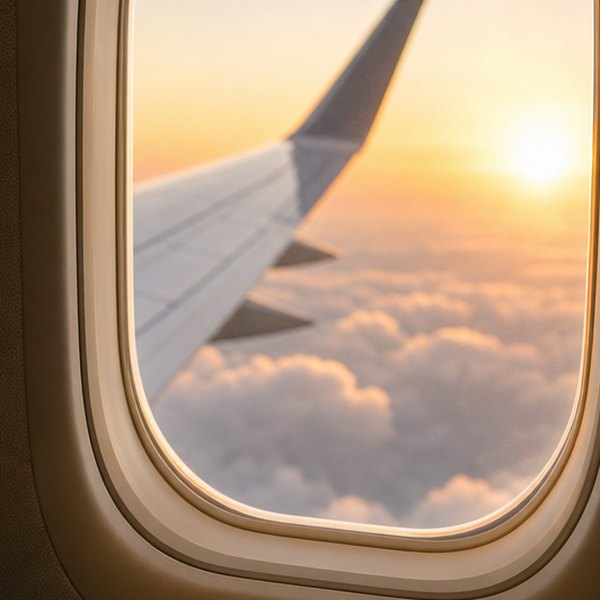
This is why jet lag isn't really tiredness. Tiredness is solved by sleep. Jet lag is your own melatonin and cortisol releasing at the wrong times – melatonin (which tells you to wind down) surging at two in the afternoon, cortisol (which tells you to wake up and be alert) flooding your system at three in the morning. You feel vaguely poisoned because, in a hormonal sense, you are.
Why is flying east harder than flying west?
Here is the part that most people don't know: flying east is measurably harder on the body than flying west, and it's down to one quiet mechanical fact. Your natural internal clock runs slightly longer than 24 hours. Left entirely to its own devices, the human body settles into a rhythm closer to 24 hours and 15 minutes.
Flying west extends your day, which suits a clock that naturally wants to run a little long. Flying east compresses it, forcing the clock to jump forward against its own preference. That's why the trip home from New York feels manageable (you're extending the day westward) but landing in Tokyo on a Monday morning and trying to feel like a human being is a different project entirely.
What Light Is Actually Doing to You
The fix, such as it is, is also light. Bright morning light at your destination suppresses melatonin production and nudges the suprachiasmatic nucleus forward. Avoiding bright screens and overhead lights in the evening lets melatonin rise on the new schedule instead of the old one. The body isn't stubborn – it just needs the right signal, and light is the instrument the destination uses to claim you.
For a genuinely interesting look at another thing that seems simple until it isn't, try The Number That Every Printmaker Knows (And Most Art Buyers Don't) over at Trivial Mouse.
The reason this matters, beyond helping you feel less dreadful in a hotel room in Singapore, is that it changes how you think about travel itself. You are not just moving your body through space. You are handing your biology over to a new sky, and it will rewrite you on its own schedule, using nothing more complicated than the angle of the light coming through the window.
Questions this raises
- How long does the body clock take to reset?
- Does morning daylight shift jet lag faster than evening light?
- Is melatonin worth taking for eastward flights?